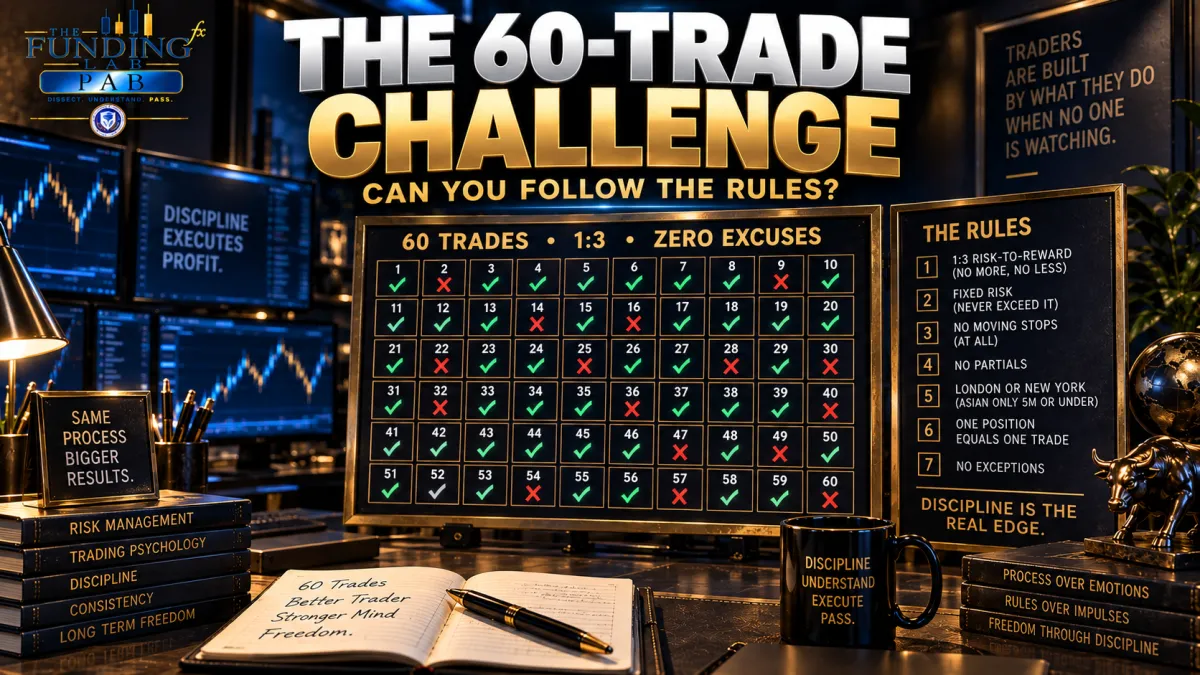
The 60-Trade Challenge: A Forex Discipline Test
The 60-Trade Challenge: The Discipline Test That Exposes Why Most Traders Never Make Money
Most traders are convinced their problem is the strategy. If they could just find the right setup, the right indicator, the right fundamental read, the money would finally show up.
I'm about to prove to you that's a lie. And I'm going to do it with a challenge, one you can run completely on your own, with no course, no signals, and no help from me. Just you, your rules, and a mirror.
I've handed this exact challenge to every single trader I know. Not one of them has completed it to the letter. Not one. And that fact, all by itself, is the most important lesson in trading you'll ever get. So here it is. Take it if you've got the discipline. Or admit you don't.
Key Takeaways
The challenge: 60 positions over about 30 trading days, roughly two trades a day.
Every single trade is locked at a 1:3 risk-to-reward. No more, no less.
Fixed risk, exact 3R target, no moving stops, no break-even, no partials, no exceptions.
Trade the London or New York session only. Asian session only if you're on the 5-minute or under.
The point isn't the money. It's exposing whether you can follow simple instructions over time.
Psychology beats strategy and fundamentals. Discipline is the thing that actually pays.
The Challenge
I'm issuing this in September 2026, and the current window runs through the end of October, but the mechanic works whenever you start. Here's the math.
You've got roughly 30 trading days in front of you. Take two positions a day and you land at 60 positions total. That's the whole challenge. Sixty trades, run to my exact rules, no cutting corners. Simple to understand. Brutal to actually do.
The Rules, Locked
Read these slowly, because the entire point is following them to the letter.
1. Every setup is a 1:3 risk-to-reward. Locked. Not a minimum you can beat, not a range. Exactly 1:3. You set your risk, and your target sits at exactly 3R. Risk $10, you make $30. Risk $100, you make $300. Every trade, the same shape.
2. Pick your risk number and never exceed it. Choose whatever amount you want to risk per trade. But once you pick it, you cannot risk more than that on any single position, ever, for all 60 trades. Consistent risk is the spine of the whole thing.
3. You cannot accept anything less than 3R. No talking yourself into "close enough." The target is three times your risk. Full stop.
4. Do not move your stop loss. At all. Not to break even, not anywhere, regardless of whether the trade is deep in profit or hanging by a thread. You set it, you leave it.
5. No partials. You do not scale out, bank a piece, or "de-risk." The trade either hits your 3R target or it hits your stop. Those are the only two outcomes allowed.
6. No creative math. Don't take one trade and try to count it as two because you feel extra confident. One position is one position. Sixty means sixty, each one standing on its own.
7. London or New York sessions only. Every position goes in the London session or the New York session. The one exception: you may trade the Asian session only if you're placing a position on the 5-minute timeframe or under, so the trade can actually play out instead of getting swept by London liquidity when it arrives. Outside of that, stay out of Asia.
That's it. Seven rules. Sixty trades. Risk management is KING. If you can't manage risk, you're COOKED, and this challenge is nothing but risk management with the training wheels welded on.
Why I'm Making You Do This
Here's the truth I've watched play out over and over. This challenge exposes traders to themselves.
Like I said, I've given it to every trader I know, and not a single one has run it exactly the way I laid it out. They make it eight trades deep and move a stop to break even. They see a "monster setup" on trade 22 and risk double. They take a partial because they got scared. They count a trade twice because they "just knew." And the second they break a rule, they've answered the real question the challenge was asking.
Because this was never about whether you can find setups. It's about whether you can follow simple instructions for more than two, three, or ten positions in a row. Most traders cannot. And that inability, not their strategy, not their fundamentals, is exactly why they can't make money.
What This Challenge Exposes
Run all 60 to the letter and this is what you'll learn about yourself:
Whether you can follow instructions to the T. For most people, this alone is the wall they can't climb.
Whether you can do the right things for an extended period. Anyone can be disciplined for a day. Sixty trades is a different animal.
Whether you're a trader or a thrill-seeker. This will smoke out the adrenaline junkies and glorified gamblers who need action more than they want profit.
Whether the math actually works. Follow the process and you'll watch the law of large numbers and simple probability start working in your favor once your constraints stay locked.
Whether trading is even for you. Some people find out here that it isn't, and that's a gift, not a failure.
Why Psychology Beats Strategy and Fundamentals
Here's the part nobody wants to hear, because it isn't sexy.
Fundamental analysis and strategy are secondary and tertiary to professional trading psychology. They matter, but they sit BEHIND your ability to execute a plan without flinching. The unsexy discipline is the thing that actually makes the money.
Let me tell you why I know, beyond a shadow of a doubt, that I'll be profitable after a certain number of positions. It's not because I've got a magic setup. It's because I know my hard numbers. I'm locked in on my risk. I'm locked in on my reward profile. I very seldom deviate, and on the rare occasion I do, the market shows me almost immediately exactly why I shouldn't have, which snaps me right back onto the stay-locked-in, stay-disciplined horse. It's boring. It works. It pays extremely well. That's the whole secret, and it's sitting right there inside these seven rules.
What Happens After You Pass
Here's why I actually want you to run this.
Once this shows up in your real trading life, once you've proven to yourself that a locked, consistent, 1:3 process produces results, a new question shows up on its own: "Since this works, how do I make it better?"
That's the question I'm waiting for. Because once you've proven the foundation to yourself, THEN we can build. Then we can sharpen your skill set. Then we can push your risk-to-reward profiles beyond 3R. Then we can close your knowledge gap with the right information instead of the random noise you've been collecting. You can't improve a process you were never disciplined enough to run in the first place. Pass the challenge, and you've earned the right to level up.
That leveling up is exactly what The Funding Lab is built for.
Inside The Funding Lab, EFXU traders take that proven discipline and stack real skill on top of it: reading the economic drivers behind the markets, mapping trading ranges, liquidity, supply and demand, and inefficiencies, and building setups and targets that go far beyond a flat 1:3. It's a room where locking in and staying disciplined is the normal expectation, for $149 a month. The challenge proves you can follow a process. The Funding Lab turns that process into a funded, repeatable income.
Take the challenge first. Then come make it better.
Join us inside The Funding Lab at thefundinglab.io.
And If You Can't?
Let me be straight with you, because somebody has to be.
If you cannot follow six weeks of simple rules, the single thing that would just about guarantee your profitability, then the honest move is to admit it. And if you're going to admit it, understand what it means. It won't just be forex. It won't be futures, options, or binary options either. It'll mean trading is very likely not the way you're meant to make your money, and the sooner you accept that, the more of your money you'll keep.
If what you're really chasing is excitement, go find your thrills somewhere that won't drain your account to zero. And if you're truly fine lighting money on fire, there are better ways to do it than feeding it to the market. Donate it. Give it to a church and help spread the gospel. Shoot, buy something from me, because if you don't know what to do with your money, I promise you I do.
But if you're serious? If you actually want this? Then stop looking for the next strategy and go prove you can follow the one you already have. Sixty trades. Seven rules. Zero excuses. Let's see who you really are.
Frequently Asked Questions
What is the 60-trade challenge? It's a discipline test where you take exactly 60 positions over about 30 trading days, roughly two a day, with every trade locked at a 1:3 risk-to-reward, fixed risk, no moving stops, no partials, and no exceptions. The goal isn't to get rich in six weeks. It's to prove whether you can follow a simple process consistently.
Why exactly 1:3 and not a bigger reward? Because the challenge is about discipline and consistency, not squeezing out the biggest possible win. A locked 1:3 removes every decision that lets emotion creep in. Once you've proven you can run a fixed process, you earn the right to push your reward profiles higher.
Why can't I move my stop to break even? Because moving your stop is the exact emotional decision the challenge is designed to expose. The moment you "protect" a trade by moving a stop, you've let fear override your plan. Set it and leave it. Let the trade hit its target or its stop.
What if I hit a losing streak during the challenge? Losing streaks are expected. With fixed risk and a 3R target, you can lose a majority of trades and still come out ahead over a large enough sample. That's the whole point. Staying locked in through the red is what proves the process, and yourself, to you.
Can I use my own strategy for the challenge? Yes. Bring whatever setups you already trust. The challenge doesn't dictate your entries, only your risk, your reward, your session rules, and your discipline. It's testing the trader, not the strategy.
What do I do after I complete it? Ask the better question: how do I improve from here? Once you've proven the foundation works, you sharpen your skill, expand your risk-to-reward, and close your knowledge gap with the right information. That's the work we do together inside The Funding Lab.
Coach MJ Worthmore is the founder of Elite Forex University (EFXU). This article is for educational purposes only and is not financial advice. Any market, commodity, or geopolitical scenarios described reflect the author's personal analysis at the time of writing and can change at any time. Trading forex and funded accounts involves substantial risk. Individual results are not typical and are not a guarantee of your own results. Always do your own due diligence.